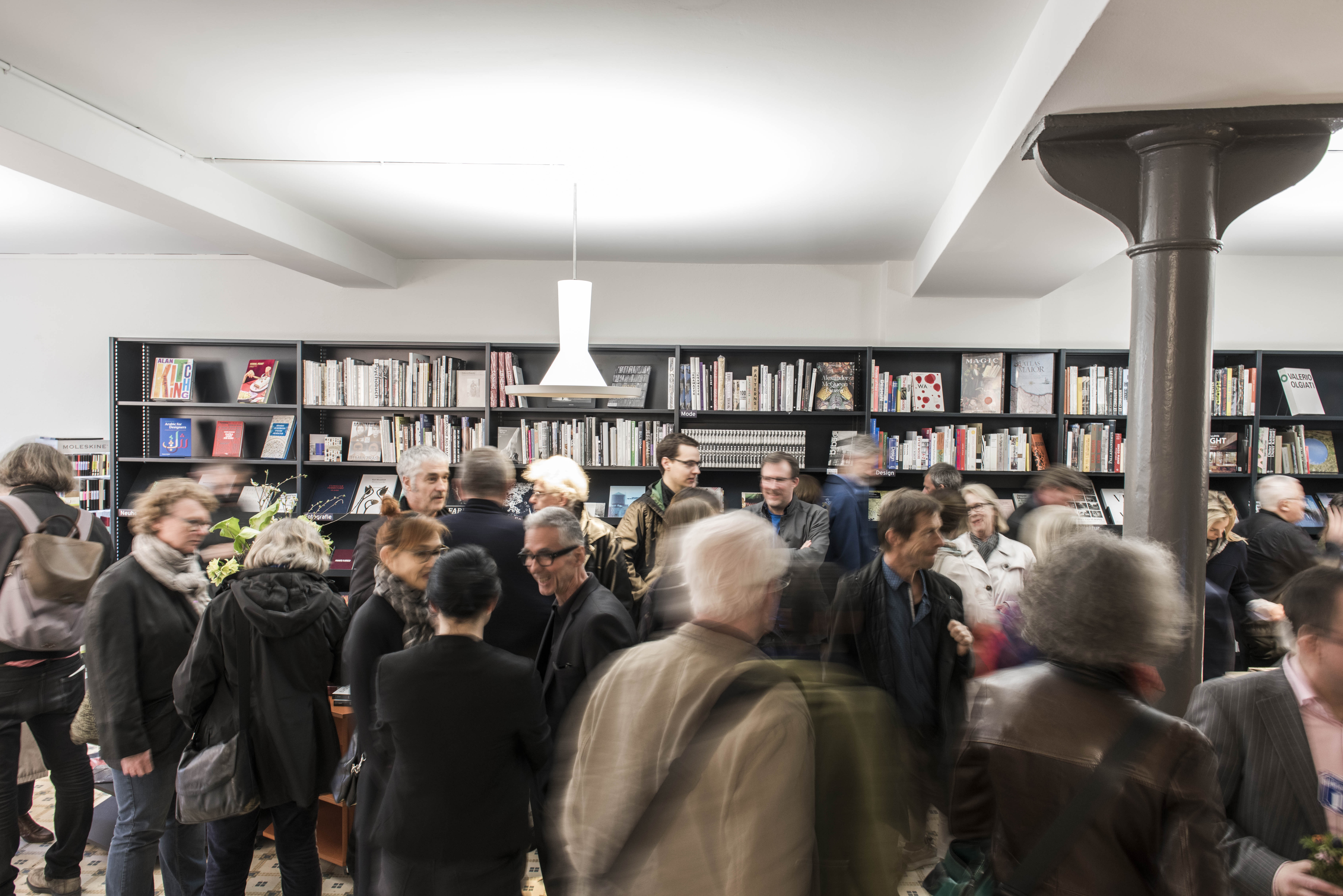
Viele Personen unterhalten sich in einer belebten Buchhandlung mit hohen Bücherregalen und heller Deckenlampe.
The Never Stop Reading bookstore has existed since 2017 and is located in Zurich's picturesque old town, at the corner of Spiegelgasse 18 and Untere Zäune. The Dada art movement was founded in 1916 on the famous Spiegelgasse, where Lenin, Georg Büchner and Johann Caspar Lavater had once lived. A little further away, but still within walking distance, are the Kunsthaus as well as the University and ETH Zurich.
The range of books focuses, surprises — and delights

Our range of products is a world of experiences! It offers a broad, internationally oriented, partly exclusive selection of books and magazines on topics such as architecture, design/graphics, photography, art, food/drinks, lifestyle/fashion, tattoos, bicycle culture or contemporary thinking.

As a partner bookstore of the Gutenberg Book Guild, we also have a department with German-language novels and non-fiction books in particularly bibliophile design and style. This reading experience is complemented by new fiction publications and a charming selection of English books.

Events and exhibitions between sense and sensuality

Our program of events consists of book and magazine presentations, readings, podiums, musical soirees or cheeky culture. So far, the focus has been on ten photography and graphic art exhibitions every year, curated by award-winning photographer Sabina Bobst. From 2026, the concept will be opened and our shop gallery will be broadened thematically.

We are rentable

Interested authors, publishers, event organizers from other industries or even private individuals can rent our attractive bookshop — factsheet

Request an Event
Our team
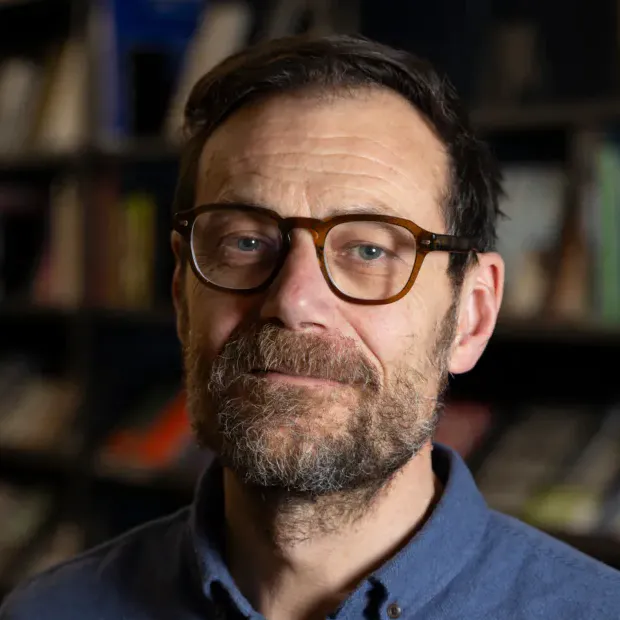
Urs

Professional
Although his father's cousin (by profession: butcher) thought that the book trade was a breadless business, Urs decided to train as a bookseller. After a detour, he ended up in the great comic bookstore “Klamauk” in Niederdorf, which was not without consequences — because he was co-founder of the grandiose comic publishing house “Arrache Coeur”. However, sales were not entirely sufficient for living expenses.

So Urs moved on to the photo agency Keystone. He later spent a few years editing pictures for the “Tages-Anzeiger”, and again later quite a few years editing pictures for the “NZZ am Sonntag”. When, in 2021, the opportunity arose rather unexpectedly to return to the bookstore through employment at Never Stop Reading — notoriously in a restaurant that had once been the processing room of a well-known butcher shop (which his relative would certainly have loved) — Urs seized this opportunity. The job, he thinks, is still fruitless, but it's also really great.

This and that
Urs has great passions — in addition to reading, of course — the gauges of model railroads, aircraft engines, the maximum risk diversification in investment funds in general and, very specifically, the influence of Bitcoin on dietary behavior. Although he then freely admits that he knows a bit about many things, but he is not at all familiar with model railroad tracks, aircraft engines, the maximum risk diversification in investment funds and, particularly precarious, the influence of Bitcoin on dietary behavior.

He finds Never Stop Reading (original sound) “the best and most beautiful bookstore far and wide.” His second favorite drink is chinotto, his second favorite food is a plate of pasta. Musically, Urs likes rumbling guitars, weird pop, post-punk, relaxed hip hop, rocksteady, dancehall, early electronics and whining American songwriters. He doesn't like handsweeping operas and operettas, folk and new German rap (if you want to be more specific, feel free to talk to him about it). Oh yes, and a literary work in which he would like to say “That's what I wrote!” , doesn't really exist; especially when he is enthusiastic, says Urs, he really treats the authors to it. But there is a book that profoundly impresses him (although he never finished reading it) — and that is Georges Perecs' “Anton Voyl's Progress.” A novel or crime thriller that does not contain the letter “e”, a tricky task, both in the original (“La Disparation”) and in translation.

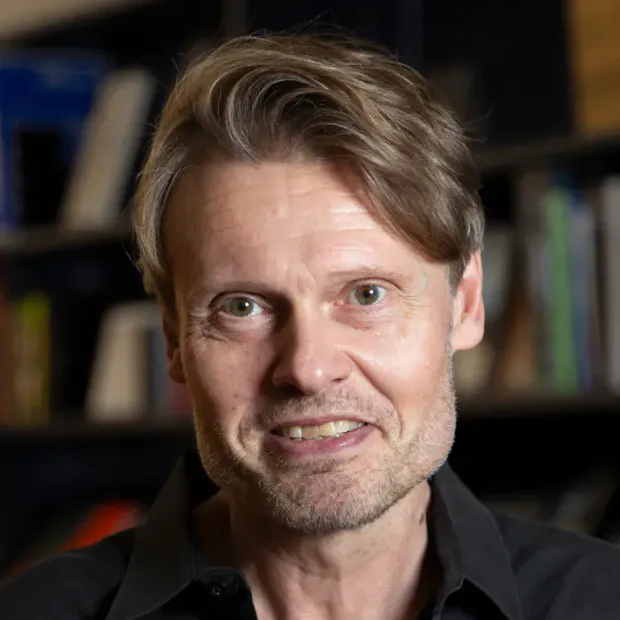
Thomas

Professional

Since he missed the gym exam due to youthful determination (no drugs, more of a kind of permanent rapture at the beauty of the world), Thomas then did a KV apprenticeship at Bank Leu Reisen. And that's obviously not that bad: In his third year of apprenticeship, he was entrusted with the Crete department; as far as he can remember, both overbookings and sales losses were within tolerable limits. He later completed the school leaving examination at the Cantonal Matura School for Adults (KME). This was followed by the years of study (law, German studies, history, film studies, social and economic history), most of which has been more or less incomplete to date.

During KME and also during studies, part-time jobs at Orell Füssli Pelikanstraße (later: Kramhof). Highlight: June 14, 1991, when all OF booksellers went on strike and we men — three to four booksellers plus a few students — tried to keep the three-story shop running. There is also a Tages-Anzeiger night seller at Zurich HB. Similar to Picasso, who famously went through a blue period, Thomas also went through a monothematic creative period. Not in art, however, but in journalism, and unlike with the Spanish painter (sorry: master painter), it lasted not three but over 20 years. Specifically, he worked as a secretary, service editor, freelance journalist, columnist and as a Zurich, sports and cultural/society editor for the “Tagi”; before, after and in between, he worked temporarily for other newspapers or magazines. At the end of this period, he finally returned to the old (and slightly rusty) love of “bookshop”. In addition to working at Never Stop Reading, he does city and museum tours and Zurich quiz evenings and writes an article now and then.

This and that
“Jolifanta Bambla o Falli Bambla//Grand Mpfa Habla Horem //Egiga Goramen//Higo Bloiko Russula Huju”. Yes, Thomas is passionate about Dadaist sound poetry. Just like the LFC, the ice-cold Rivella red on ambitious hiking trips, the “oven hole” and so much in Vienna, Monty Python, “Blow Up”, “Zabriskie Point” as well as Italian silent films, St. Pauli (as a district and as a club with attitude), first movements in general and also almost all movements of Pynchon, DJ playing, insatiable curiosity, Nostalesch's theatre, stories from Zurich and unfortunately much more for which a lifetime will never be enough.

His favorite place in the shop is the natural table by the sofa, where he finds peace even in the hustle and bustle. His second favorite food (seasonal) is “Mara des Bois” strawberries or Uva americana. Musically, he likes the same thing as Urs, minus the whining American songwriters, plus previous Italian summer hits, trip hop, jungle and drum'n'bass, surf sounds, minimalistic techno stuff. Oh yes, and the book where he thinks “I would have loved to write that myself!” , he has read many times — but unfortunately he hasn't written it himself yet.

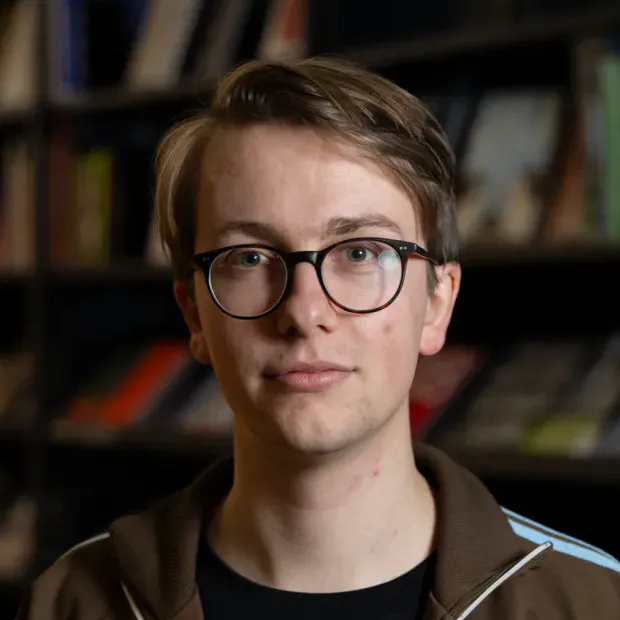
Maurin

Professional
Probably inspired by famous chemists such as Marie Curie (radioactivity), Antoine Lavoisier (oxidation), Dmitri Mendeleyev (periodic table) and Otto Hahn (nuclear fission), who all started out in the laboratory, Maurin completed solid basic training as a chemical laboratory assistant. He then completed his Matura on the second path of education. Although many were convinced that this solid additional education was the logical next step on the long road to the Nobel Prize in Chemistry, Maurin chose to study geography and philosophy (and thus selflessly in exchange for prize money and to save the world, chapeau!)

Maurin used to finance his living and studies primarily through jobs in the catering industry, including working at the legendary restaurant “Schiwago”, which closed in December 2025. He now works as a care assistant at the Hardau school... and of course at Never Stop Reading. In doing so, he can combine the useful with the pleasant, namely contribute his expertise, post the Insta news, satisfy his (immense) coffee needs and further expand his proud collection of architecture, art and photo books.

This and that
Play soccer, watch soccer, collect soccer jerseys: Maurin's passion #1! That is why he would immodestly award himself the title of “soccer expert” if anyone asked about it — and explicitly not just during a euro or a World Cup, but year in, year out. Watch movies and go to the cinema: Maurin's passion #2! (However, it is not yet enough for him to become a self-proclaimed expert). He describes Never Stop Reading as “one of my favorite places in the city,” and within this favorite place he stands — no big surprise, see above — preferably near the espresso machine.

Since we're on to the food: Maurin's second favorite food is either Moules et Frites or Spaghetti Vongole (the other is then his favorite dish, but he couldn't decide). His musical preferences are completely different: Gorillaz, Björk, Aphex Twin, Burial or Rosalia to rap with lots of autotune, such as the French duo PNL, Young Thug or Triad God. Oh yes, and then there is the book where he would like to say: “It's mine, by the way.” book? books! Specifically, this applies to all Simenon's “Maigret” crime stories, as well as Hegel's “Phenomenology of Mind,” Foucault's “Surveillance and Punishment,” Judith Butler's “The Discomfort of the Sexes,” and finally to “Dialectic of Enlightenment” by Horkheimer and Adorno.

It's not a bookstore you come to looking for something. This is where you come to find something.
Remarkable remark from a customer during the 2023 Christmas season.

In place of today's corner house Untere Zäune/Spiegelgasse 18 — i.e. where the Never Stop Reading bookstore is located — there must have been three houses in the Middle Ages: one right on the corner, the other two in a row on the Untere Zäune. In any case, a first mention of the buildings in a Certificate dated June 21, 1319 close.

In it, the Council states that Knight Rudolf Mülner As a nurse of the “Mindern Brüder” (Franciscans), sold the rear part of a house “daz gelegen is under Nidern Zünen” as Leibding to Sister Guta of Ebmatingen for 24 pounds. On the one hand, the house was adjacent to that of Schwarzmurer (Untere Zäune25) and also to the house in which Mrs. Meiß lived; this may have been identical to the corner house.

In another document from 1535, Junker Hans Jakob Rordorf named as the owner of the house at today's Spiegelgasse 18. An impetus of his property to the house “zum Grünen Kreuz” (today: Untere Zäune 25, the neighboring house of Never Stop Reading) is also emphasized. From this mention, it can be concluded that a new corner house has been built in place of the individual buildings mentioned above. Junker Rordorf, married to Helena von Hinwil, became a constafflord in 1551 and thus a member of the Council.

The “Rordorf House” is also located on the famous “Murerplan” from 1576 Acknowledge. This detailed woodcut city map of Zurich, created by the glass painter and cartographer Jos Murer, is considered the most important and oldest postcard of the city from the Renaissance, which precisely depicts buildings, roads and the urban structure of the time.

1621 Junker leads Hans Heinrich Grebel, the former owner of the corner house (today: Spiegelgasse 18/Untere Zäune), underwent a major renovation. “After that, the building has the outer aspect with the three full floors, which it has essentially retained to this day,” as can be read in a report from the Building History Archive.

This house also grows Grebel's son Hans Konrad (1615-1674), who marries the daughter of Mayor Salomon Hirzel in 1640 and thus manages to rise to the highest offices. He had already been a member of the Grand Council before, later he became bailiff in Wädenswil, then guild master zur Meise, later Zurich governor and year Finally mayor in 1669. After the death of his father, Hans Konrad Grebel inherits the corner house, which was built for the first time in documents from 1658 “Rock egg” is called.

However, the name “Felsenegg” does not have to be associated with the Felsenegg on the Uetliberg. After Spiegelgasse in the previously mentioned Murerplan as Steingasse It is obvious that more existing rocks probably inspired the name. This is also supported by the boulder, which was discovered around 1630 during the enlargement of the existing “Felsenegg” cellar (which is now used as a cultural and event space) in its east wall and is partly dismantled with great effort.

In the house index of the first geometric plan of Engineer Johannes Müller, which was built between 1788 and 1793, is that “Felsenegg” house worth 12,000 guilders listed. Based on historical data on the purchasing power of guilders in the late 18th century, this could correspond to a current equivalent of 115,000 CHF. Although this is a very rough estimate, as the cost of living and the economic structure have fundamentally changed over the past 230 years — at the end of the 18th century, you could buy around 10 kg of bread or 2 kg of beef for one guilder in Zurich.

In the September 18, 1925 issue of “Neue Zürcher Nachrichten”, the obituary reproduced here in extracts can be read, which is of great relevance for our bookshop: At that time, our current shop was the slaughterhouse and sausage-making room of the posthumously honored in the following lines Metzgers and Pius Ruff:

“Last Monday, a man was buried who deserves to be remembered here. Pius Ruff was born on July 9, 1859 as the son of a peddler living in poor conditions in Jungingen (Hohenzollern). He lost his mother when he was just two years old and was therefore put on his own feet at an early age to earn his living. As soon as he was released from school, he became a stagecoach, then he went on the “roll” and learned the butcher business from a farmer's butcher in general.

After completing his three-year military service, he, following his instincts, turned to Switzerland. In Zurich, which became his second home, he soon found employment with the first companies and thoroughly acquired the beneficial knowledge of sausage production, but wisely kept it to himself. In the house of one of his last masters, he studied Ms. Ursula Ehrat von Lohn (Schaffhausen), with whom he entered into the marriage, which resulted in a son and two daughters... (...)...

In 1885, at the insistence of his wife, the deceased set himself up in the extension of the Spiegelgasse 13 house in Zurich. As a result of the friendly service and the sale of only good goods, the number of customers always increased and soon required expanded locations, What became possible with the purchase of the house Spiegelgasse 16 and later No. 18 ... (...)...

Pius Ruff had a large support in the business operations of his wife, but this was snatched from him by death on January 5, 1916. The son and two daughters supported him with great interest. The goal that Metzgermeister Ruff was constantly heading for was the upswing of his business and the purchase of the latest and most modern machines. How brilliantly he succeeded in raising his business is proven by the simple fact that he had a daily income of 75 francs at the opening; today, the average daily income of the extensive company is 30,000 Fr.! After remarriage at the end of 1920, Pius Ruff retired to private life, but always kept a watchful eye. The business passed to the son Otto Ruff... (...)...

The big strong man was struck by an insidious illness, which he succumbed to after suffering for several months. Despite his lively, outward thoughts, he did not forget his membership of the Catholic Church and died unintentionally with the Sacraments of the Sacred Death. HH-. Vicar Konrad from the parish of Our Lady addressed warm and heartfelt words of consolation to the victims at the grave, where around 2,000 people were still present. The survivors mourn a kind-hearted husband and father. He always set a good example for the employees and was very popular. Anyone who knew him will never forget him. May the earth be easy for him!”

Picture: Advertisement Pius Ruff butcher shop from 1915. (Source: Building History Archive of the City of Zurich)

After the butcher's apprenticeship, the Son Otto Ruff Graduated in his local business, his father sent him to school in Neuchâtel, then to Germany, and in 1913/14 even to Chicago in the USA, where he “personally got to know the large American meat processing company” (as can be read in 1945 in the speech on his abdication, which took place in the Grossmünster in the presence of many honorary guests).

From then on, Otto Ruff, like his father, was interested in machines and technical achievements of all kinds, especially in order to always achieve the highest quality of manufactured goods. In 1917 he married Anna Fassnacht. It is explicitly emphasized in the abovementioned abdication that “together for 27 years they would have carried the joy, work, happiness and worries of a large company rising through struggle and resistance.”

In 1920, almost four years after the wedding ceremony, Otto Ruff took over the management of the butcher shop and sausage production from his father. Since the shop and slaughterhouses and production rooms in District 1 have now become too small, he acquires the area on Uetlibergstraße in Wiedikon from the Hürlimann brewery in May 1923 and converts the brewery into a sausage factory. “In January 1924,” it is written in the abdication speech, “the young patron himself moved up the hill above Uetlibergstraße, settled in and lived there until his death.”

A special retrospective mention is given to storefront of the butcher shop in a report on the preservation of historical monuments, which it published in 1983 on the occasion of renovation work: “The shop façade built in 1903 for the Ruff butcher shop stylistically shows the transition from historicism to Art Nouveau. The use of rolled iron profiles and machine-embossed decorative strips in combination with hand-forged flower tendrils and cast flowers is typical of the turn of the century, when industrial production and craftsmanship could still form a synthesis in architecture. The façade, which looks precious due to the colors blue and red and the rich use of gold leaf, is also an example of the professional pride of the butcher, who wanted to show the prosperity he had achieved through diligence and efficiency. Photos taken to mark the company's 50th anniversary in 1935 still convey something of this self-image. The meat was still hanging back then in the form of half or quartered animal bodies easily visible in the shop window.”

Picture: Metzgerei Ruff shop window at Spiegelgasse 18, photo from 1925. (Source: Building History Archive of the City of Zurich)

Around 1930, the old town around Spiegelgasse and Untere Zäune is a (also visually) poor and desolate area. If you look closely, the picture of the Lower Zäune shows our current shop window; according to city archaeological documents, it was built during a renovation by butcher Pius Ruff in 1907.

Picture: Photo of Untere Zäune from 1930. (Source: Building History Archive of the City of Zurich)

Although Otto Ruff famously moved the company headquarters to Uetlibergstraße in 1923, the old town branch remains the butcher shop — today there is the fashion label there Selection theme leased — including slaughterhouse and sausage factory (where, as already mentioned, Never Stop Reading is located) until the mid-1940s.

Picture: Spiegelgasse with sausage factory and butcher shop Otto Ruff in a photo from 1938. (Source: Building History Archive of the City of Zurich)

Rolf Pius Ruff, grandson of the company founder, sells the old town houses “Sheepli” (Spiegelasse 16) and “Rock egg” (Spiegelgasse 18/Untere Zäune) 1946, one year after the death of his father Otto, to the Ernst Göhner Foundation. In turn, she sold them to the city of Zurich in 1947. The pictures of the Lower Zäune from 1950 and 1959 show — latticed — the shop window of our bookshop. The picture of the neighboring Leuengasse from 1959 is also a great document. The photograph shows that — with the exception of children's toys, fashion and the size of the treetops — virtually everything is still the same today as it was back then.

Picture: Leuengasse in a photo from 1959 (Source: Building History Archive of the City of Zurich).

1998 goes with the liquidation of Genossenschaftsbuchhandlung Pinkus am Zähringerplatz An era is coming to an end. Whose dazzling figure was Theo Pinkus (1909-1991), a communist Jewish maverick, founder of the BSV book search service, a second-hand bookstore, a socialist bookstore, initiator and co-founder of the Limmat publishing house, married to the bookseller and women's rights activist Amalie Pinkus-De Sassi, with whom he also founded the 50,000 works study library on the history of the labor movement, politically active in the Communist Party (excluded), with the SP (excluded) and most recently at the Labor Party PdA, in addition, Pinkus had at the Swiss News Service with 252 Pages the most extensive of all created fiches, as became known when the scandal in 1989 was discovered.

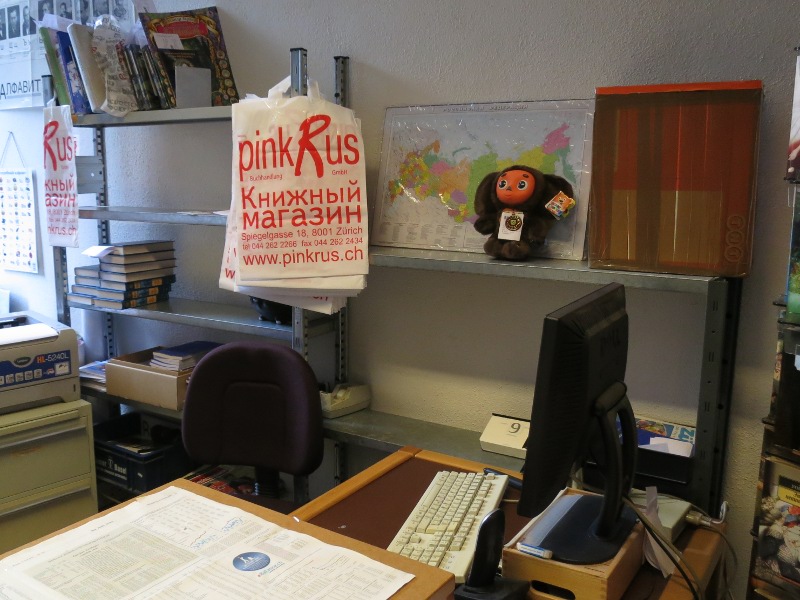
With Jules Hunsperger, however, one of the former Pinkus employees is keeping socialist ideas alive in book form — by writing the Russian bookstore “Pinkrus” opened. Product range: Russian contemporary literature, crime stories, entertainment literature, new publications from recent months, classics, translations of fiction from German and English, non-fiction books on geography and politics. Customers: Slavists, translators, Russian authors such as Mikhail Schischkin, who live in Switzerland or are passing through. Gathering information: Acquaintances and friends in Russia are watching the domestic book market for Pinkrus and drawing attention to new publications.

All of this can be found on the buchort.ch portal. Just like the fact that Hunsperger took care of the administration at Pinkrus and hired former Russian radiologist Elena Seiler to advise customers. Or that the continued existence of the shop was also due, among other things, to the city as a squatter and its real estate administration — because the city did not want to lose the bookstore.

Picture: Pinkrus bookstore recording with cash register (Photo: buchort.ch, Heinz Egger)

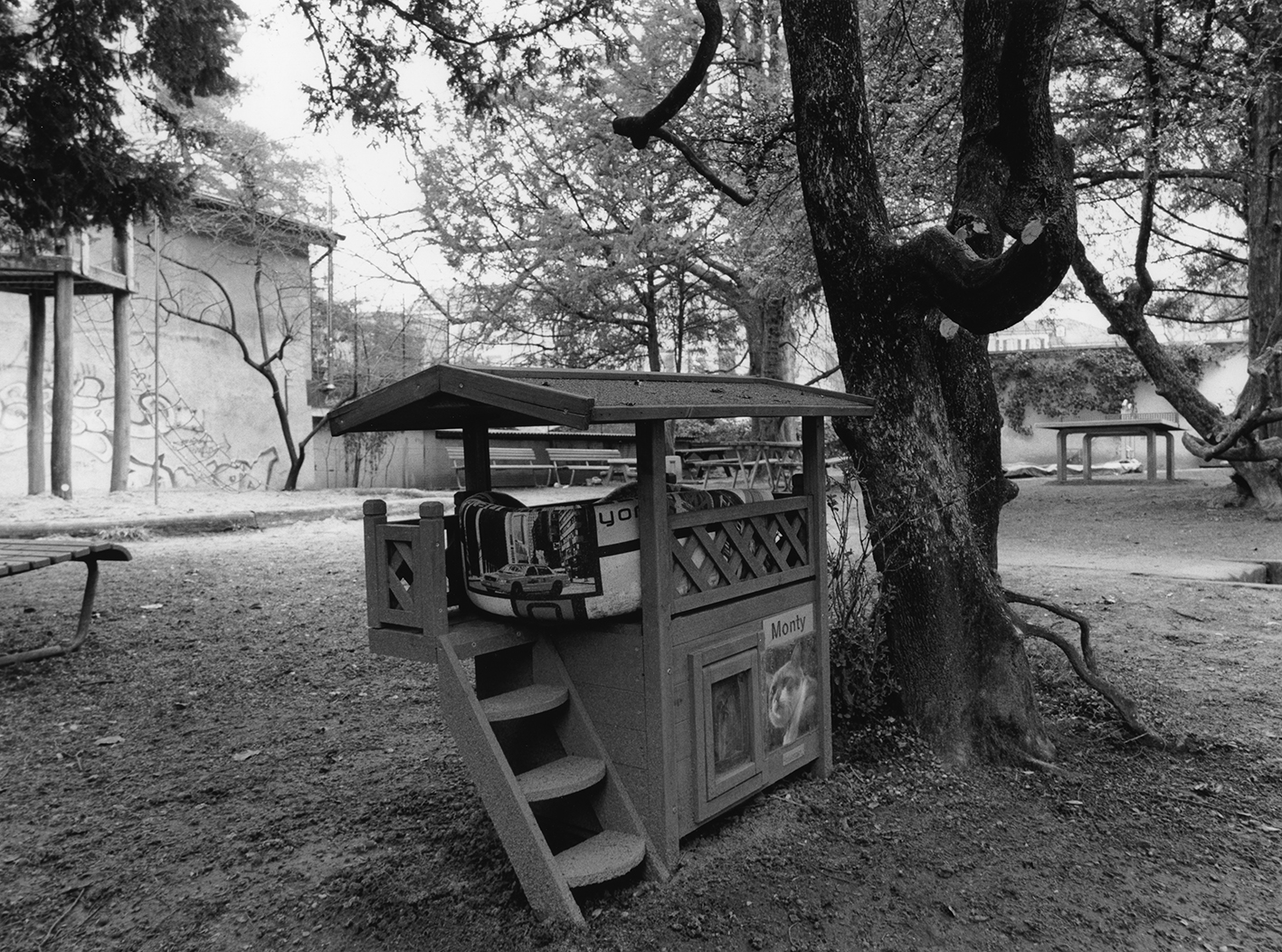
The parkli opposite our bookstore is, so to speak, our extended “Living Room” — here we hold meetings and summer parties, here we munch on salads and sandwiches when the sun is shining, here we eat Filou and Gino (or they us), the four-legged friends from the neighborhood.

The two tomcats are the (non-blood related) successors of the legendary Monty, who was “everybody's darling” in this old town area from 2004 to 2016 and had his stately hut in the park. After he is run over by a car, his owner Serge and many residents of the old town who have been touched by his fate set him a memorial: They collect 5,000 francs and have a bronze statue of Monty cast. In order to set them up, an exemption from Grün Stadt Zürich is required, which is (provisionally) limited to ten years.

Picture: Cat Monty's house in a photo from 2016. (Source: Building History Archive of the City of Zurich)

On Thursday, April 6, the Never Stop Reading Bookstore opened at Spiegelgasse 18/Untere Zäune. The “Tages-Anzeiger” published the following article at the time of birth:

“The name says it all: “Never Stop Reading” is the name of the new bookstore in Oberdorf. It is located on the corner of Untere Zäune/Spiegelgasse 18, where Lenin and Büchner once lived and Dada was born. A wonderfully atmospheric bookstore has been created here, which offers an international range of architecture, art, photography and design, an assortment “that has not been staffed so broadly in Zurich for a long time,” as Thomas Kramer, managing director of the art book publisher Scheidegger & Spiess, explains. A selection of English books, non-fiction and fiction will also be available.

Not far away was Robert Krauthammer's bookstore, which was the first point of contact in Zurich for exactly this range of products. Orell Füssli then took over the business in 2001 and launched it a larger size in the former Racher stationery on Marktgasse 12. Ten years later, Orell Füssli closed the branch in Niederdorf and integrated the offering into the main store at Kramhof. Last year, this department was also downsized so that the publishing house Scheidegger & Spiess no longer had a sales outlet in Zurich. “Sales in Zurich were less and less comparable with those in German cities,” says managing director Kramer.

That should now change. Despite Amazon and the Internet, new bookstores are emerging again. Kramer mentions examples from England and Berlin: “This involves bookstores with a selected range of products.” This development is now also being noticed in Zurich. The decisive factor for success is that bookstores are not zero-eighteen restaurants. 'Never Stop Reading' is intended to convey 'enjoyment and shopping experience. ' The large, lengthened room bears the signature of architect Adriana Stalder from the Zurich office Stalder & Buol. The restaurant, which once had a butcher shop, is a listed building and is a combination of old and new. The landlord is the real estate administration of the city of Zurich. A very long, anthracite-colored bookcase stretches along one wall, in front of it are the latest book trouvailles on chic colored tables, skylight windows illuminate the main room.

The bookstore is financed by the owners of the publishers Scheidegger & Spiess and Park Books. These are the Meili brothers, lawyer Andi Hoppler and Thomas Kramer. “However, the new store is not a showroom for our books,” Thomas Kramer points out. “It must also pay off financially.” An important part of the range includes works from other Swiss publishers who also specialize in photography, art and architecture. These include Lars Müller Publishers, Edition Patrick Frey and Quart Verlag from Lucerne.

In addition to around 4000 beautiful books to browse through, “Never Stop Reading” will also regularly host photo exhibitions. They are curated by photographer Sabina Bobst. Photographs from the photo book “Bilbao” by Roger Wehrli from Baden make the start. He recorded the transformation of the Basque city between 1988 and 2014 and shows how the former industrial juggernaut became a cultural capital. Readings and discussions are also planned. The bookshop is run by Nora Schwyn. She worked at sec52 from 2008 to 2017.”

On Wednesday, September 11, we have an international star guest at Never Stop Reading: The famous American “Magnum” photographer Alec Soth, who is in Switzerland to present his work “Limmat Valley Diary” as part of the “Art Flow” art project, gives a whimsical, one-hour presentation in our shop about his work and his latest book “Advice For Young Artists.” Visitors travel not only from half of Switzerland, but also from Germany, Italy and Austria; quite a few listen to the presentation from the sidewalk because there is no room in the shop anymore.

Another high-profile visitor, but this time from an unrelated sector: In the late afternoon of June 17, there is suddenly a stroll Thomas Tuchel, Coach of the English national soccer team, by Never Stop Reading. He was on his way to the Club World Cup in the USA, but his plane from London was unable to land due to too much wind, so he missed the direct flight. Tuchel stays for almost an hour, praises our selection and regrets traveling only with hand luggage, otherwise he would buy more than three books. Most of the time, however, you talk about soccer, of course.

But that's not all: Around a week later, on June 25, the world-famous fashion and cosmetics label CHANEL is launching its new one at Never Stop Reading Chanel Arts & Culture Vol. 1 magazine. The opening of the book-thick debut takes place all over the world on the same day in 20 selected bookstores.

Picture: English national soccer coach Thomas Tuchel (Source: PD)

2025
2024
2017
2016
1997
1950
1938
1930
1920
1885
1788
1621
1535
1319